

Admiral Jayanath Colombage Visited Shanghai Institute of International Studies
Time: 2026-11-17 Author: RCAS
Admiral Prof. Jayanath Colombage, a Non-resident Senior Fellow of Hong Kong Research Center for Asian Studies, was invited to visit the Shanghai Institute of International Studies (SIIS) on 12th November 2026 to engage in an in-depth strategic discussion on contemporary Maritime Security Situation of Sea Lanes and the Development of International Cooperation Mechanisms across the Indian Ocean Region”. Admiral Colombage met with the Vice President Dr. Li Kaisheng and a group of senior research fellows, Directors who are specially focusing on the Indian Ocean, South Asia, International Law and American studies.
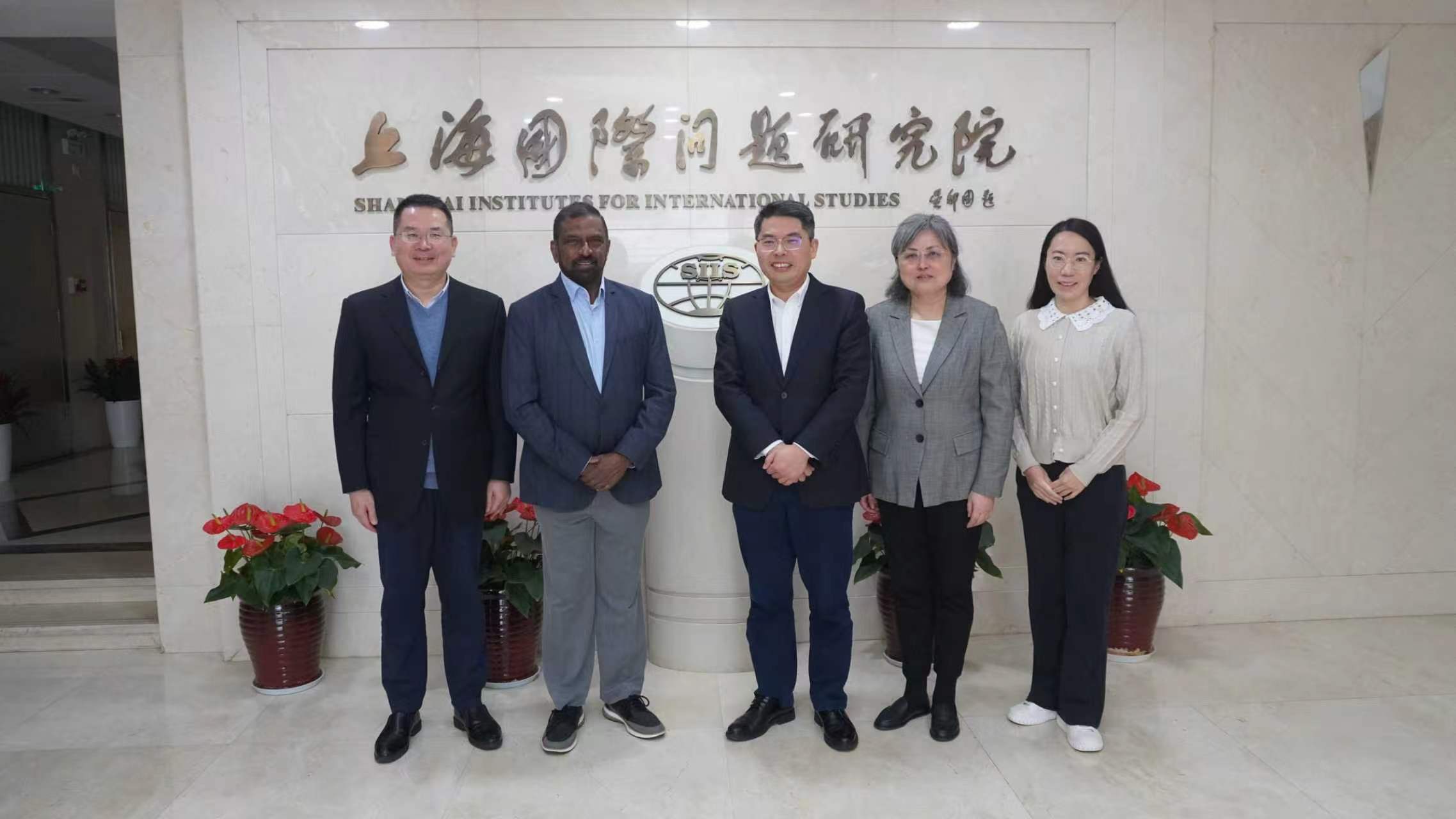
The Shanghai Institutes for International Studies (SIIS) was established in 1960 as a comprehensive research institution, one of the earliest government-affiliated think tanks in China dedicated to international studies. At its founding, Mr. Jin Zhonghua (Ching Chung-Hwa), then Vice Mayor of Shanghai and Vice Chair of the Shanghai People’s Political Consultative Conference, was the inaugural president. Over the past six decades, SIIS has played a crucial role in conducting strategic research, providing policy recommendations, and contributing to the understanding of international politics, economics, security, and other related fields. It has evolved into an important institution informing and shaping China’s foreign policy and global engagement, and has been accredited as one of the most influential think tanks in China and around the world.
Admiral Prof. Colombage delivered a talk focusing on: The changing strategic environment of global sea lanes, geopolitical competition, militarization and the shift from maritime connectivity to strategic contestation, emerging and evolving maritime security threats: chokepoint disruptions, armed attacks, grey-zone activities, cyber threats, unmanned systems and threats to subsea infrastructure, International maritime law and freedom of navigation: UNCLOS, navigational rights, coastal-state jurisdiction, legal ambiguities and enforcement challenges, existing international cooperation mechanisms and their limitations- IMO, IORA, IONS, ReCAAP ((Regional Cooperation Agreement on Combating Piracy and Armed Robbery against Ships in Asia), Djibouti Code of Conduct and regional security initiatives, IFCs, and Colombo Security Conclave (CSC) and MDA.
Admiral furthermore discussed the role of small and middle maritime power, Sri Lanka's perspective, strategic autonomy, cooperative security and the principle of being neutral but capable. Admiral Colombage concluded that effective maritime security cannot depend exclusively on naval superiority. It increasingly requires shared maritime domain awareness, reliable information exchange, legal cooperation, crisis-management mechanisms and stronger national enforcement capabilities. He further stated that Small and medium-sized littoral states must be treated as active contributors to maritime governance rather than merely recipients of security assistance. Admiral also suggested developing a future maritime security cooperation architecture as Maritime Domain Awareness, information sharing, confidence-building measures, institutional coordination and capacity development. The talk was followed by an in-depth discussion by the faculty of SIIS with Admiral Prof. Jayanath Colombage.