Admiral Jayanath Colombage Delivered Lectures in NISCSS
Time: 2026-04-25 Author: RCAS
Admiral Prof. Jayanath Colombage, a Non-resident Senior Fellow of Hong Kong Research Center for Asian Studies, was invited to deliver lectures at National Institute of South China Sea Studies (NISCSS) and Huayang Centre for Maritime Cooperation and Ocean Governance from 19th to 22nd April 2026. Admiral delivered two lectures titled “Strategic Balancing in the Indian Ocean: A case study of Sri Lanka- China Relations”, for NISCSS and “India Ocean Maritime Security Dynamics”, for Huayang Centre in Haikou, Hainan, China.
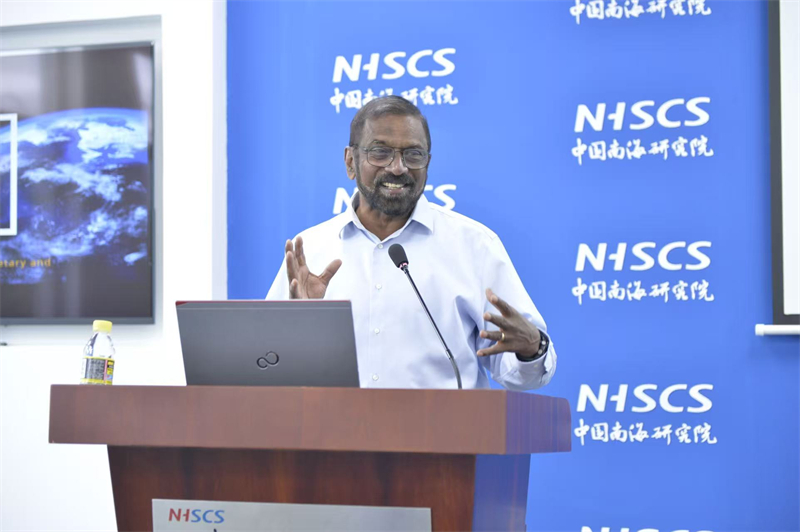
Speaking on China-Sri Lanka relations Admiral highlighted that Sri Lanka is in a Geo-strategically, Geo-economically and Geo-politically important location in the Indian Ocean and Sri Lanka is one of the first members of the BRI and an important country for maintaining Maritime Security which facilitate Sea-borne tarde across the Indian Ocean. Sri Lanka need to develop quality infrastructure especially in the Maritime sector and hence need to continue to benefit from the Belt and Road Initiative 2.0.
Admiral further indicated that the Indian Ocean is very rich not only with fish and hydro carbons and sea bed minerals but with Maritime Strategies too. Are these strategies actually to maintain peace and order in the Indian Ocean? Or are they to further the national interests of major powers? The Strategic Competition and Convergence are only for major players. The Indian Ocean is peaceful. By trying to make it more peaceful we make it insecure. Admiral indicated that Sri Lanka and China have enjoyed historical ties for win-win cooperation in South Asia. Concluding this topic, Admiral stated that: China-Sri Lanka relations is at a very strong position. Exchanges at all levels have increased. Practical cooperation has steadily increased. Mutual support has been strengthened. Maintained positive Momentum in International and Regional Affairs. There are Challenges from other major powers. China and Sri Lanka need to work harder for win-win cooperation and benefit of our People.
Discussing the topic on Maritime Security Admiral highlighted that the India ocean connects four continents: Asia, Africa, Australia and Antarctic. It is home for one-third of world population. The Indian Ocean contains large quantities of ‘Strategic Natural Resources’. Its waters constitute the lifeline with 2/3rd world crude oil shipments, 1/3rd of bulk cargo and half of containerized cargo.
Admiral Colombage listed some criteria to identify strategic flash points in the Indian Ocean as Chokepoint vulnerability: Hormuz, Malacca, Bab el-Mandeb, Great power rivalry: Especially U.S.–China competition. India-China, Historical Animosity: India-Pakistan, India-China, Pakistan- Afghanistan, Territorial disputes: Mostly settled, Chagos Archipelago is pending, Energy security: Oil and gas transit routes are central, Trade Security: Seaborne trade/maritime commerce, Supply chain security, food security, Naval militarization and Nuclearization: Expanding fleets, submarines, and Military Bases: Diego Garcia, Djibouti.
In addition to traditional and non-traditional maritime security threats in the Indian Ocean Admiral indicated the new dimension of threats as shore based ballistic and Anti-ship missiles, shore based drones, Unanimous Surface Vessels with Explosives, Anti-ship mine fields, Torpedo Attacks and Attacks by submersibles. Admiral concluded the lecture by saying that We need peace, stability and international rules based maritime order in the IOR. We don’t need a single hegemonic power. No single country can be a net-security provider in the IO. The need of the hour is of strong political leadership which can look beyond own territory. We need Common, Collaborative, Comprehensive and Sustainable security in the IOR as highlighter in Chinese initiative of Global Security Initiative. Many Indian Ocean littorals want balanced neutral foreign policies- balance engagement with all major powers even as the pressure to choose continues to mound.