Middle East Crisis As Catalyst: Pakistan In The Shadow Of Sino-US Competition
Time: 2026-05-04 Author: Sujit Kumar Datta
The recent Middle East crisis has highlighted the region’s security instability, but also the opportunity for middle powers to play a role. In this respect, Pakistan is an interesting case, as it sits in between the new Cold War between China and the US, and can play the game. Crises are not only a time bomb for the region, but also an opportunity to boost Pakistan’s position and prove its diplomatic, domestic, and geopolitical agility.
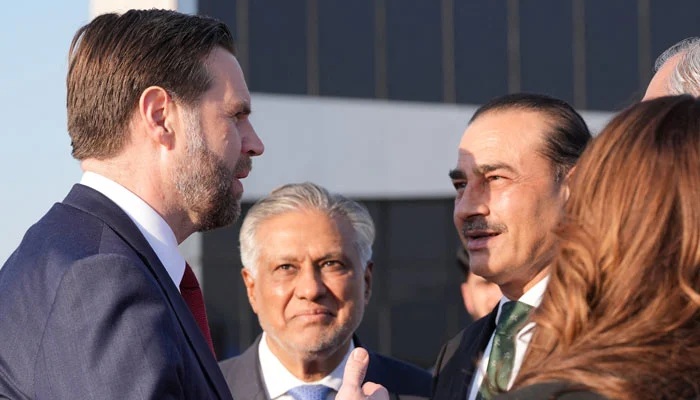
▲US Vice President JD Vance talks to Pakistan's Army Chief, Field Marshal Asim Munir and Pakistan's Deputy Prime Minister and Foreign Minister Mohammad Ishaq Dar, before boarding Air Force Two, after peace talks with Iran in Islamabad on April 12, 2026. — Reuters.
Pakistani foreign policy has always been a juggle. It is, of course, China’s “all-weather” ally, with strong economic, military, and infrastructural ties, such as the China-Pakistan Economic Corridor (CPEC). It is a new – but also renewed – friend of the US, particularly in the areas of security and terrorism. This is Pakistan’s greatest wartime weapon. The Middle East conflagration the US and Iran have given Pakistan an opportunity for “mediation diplomacy”. Pakistan’s geopolitical and geo-strategic position vis-à-vis Iran and Saudi Arabia makes the situation interesting. It has an open and disputed border with Iran and a military alliance with Saudi Arabia. It is a sensitive time for diplomacy and restraint.
Asim Munir plays an important part in this geopolitical transformation. His involvement in last year’s “small war” with India has elevated his standing on the international stage as a decisive military leader. In a world in which some believe leaders like Donald Trump speak the “language of power”, Munir is now a certain kind of man that the US prefers. It has led to Trump inviting Munir for a private lunch at the White House on 18 June 2025 – a first for a US president and a Pakistani army chief, in the absence of the latter’s civilian counterparts. In calling Munir “a great warrior” and “a very important person”, Trump was acknowledging the US’s debt to Pakistan for its role in ensuring regional security.
This was a coming out. It was backed up by Pakistan’s support to the US Central Command of the US military, especially in the arrest of a suspected leader of the Abbey Gate attack. The 26 August 2021 killings during the US withdrawal from Afghanistan had a major impact on the US strategy. Pakistan’s cooperation here re-established trust and its value in countering terrorism.
In this regard, Pakistan’s role in the 8 April two-week truce between the US and Iran is important. The telephone calls between Munir, US Vice President JD Vance, and Iran’s Foreign Minister Abbas Araghchi prevented a war. This is an instance of Pakistan being a “swing state” – capable of talking to both sides of a conflict, but not being beholden to either.
This achievement needs to be balanced with Pakistan’s issues. The unrest and instability in Balochistan are failures for Pakistan. Pakistani unity is important for its foreign policy; otherwise, its plans can go awry. Problems in Balochistan also affect geopolitics, as the province is crucial for the China-Pakistan Economic Corridor (CPEC) and borders Iran.
The other factor is Pakistan’s economic vulnerabilities. The recent US developments, such as partnerships in rare minerals and cryptocurrency, are indicative of economic partnerships. However, they are also a part of the US-China rivalry for market share in emerging markets. The Pakistan government must be cautious with these deals and ensure that they do not backfire.
In this context (albeit quietly), China matters. China has helped Pakistan develop and enhance its stability and is a peace advocate in the Middle East. Pakistan can supplement its behind-the-scenes mediation efforts to advance diplomacy on several fronts. This is a significant element of bilateral relations: complementary.
Pakistan can learn some lessons from its mediations. First, it is worth being neutral, but believable. Neutrality can be active, as Pakistan’s mediations between the US and Iran show. Second, information is key. Meeting with various parties, as Pakistan did in April, can soothe and build confidence. Third, there are structural constraints. Pakistan has economic and security concerns. These need to be considered in the foreign policy process. Fourth, coordination, particularly between political and military decision-makers, is crucial. Although Munir has been a critical leader, a more coordinated military-diplomatic approach is essential for success. Fifth, Pakistan will have international support. Islamabad should be active in regional and international forums. Moreover, it should be pragmatic. In a multipolar world, Pakistan should be pragmatic, flexible, and interested, but not ideological.
The Middle East crisis is thus not only a challenge for Pakistan’s foreign policy but also a call to reset it. Its geographical location between several geopolitical hotspots means Pakistan can play a role in stabilizing the region. However, it must be able to handle both its foreign and domestic policy and strategy. About the China vs the US dynamic, there are risks but also opportunities for Pakistan. If it can achieve this, “swing state” Pakistan will become a small-to-medium player in world affairs. There are both threats and challenges for Pakistan to recraft the world.
In all, the Middle East crisis has highlighted Pakistan’s strategic dilemmas and cemented its traditional balancing act amid the China-US rivalry. As China’s “all-weather” ally, Islamabad cannot help but be part of Beijing’s strategic considerations, a fact evident not only in infrastructure and economic initiatives but also in its cautious stance toward regional conflicts. At the same time, the US is an indispensable security and strategic ally, particularly in defense. Pakistan’s defense agreement with Saudi Arabia also adds to the complexity of the situation, as Saudi Arabia is vying with Iran, with which Pakistan shares a porous border. This poses an immediate security challenge, particularly amid rising tensions.
To these external considerations can be added domestic issues, especially the situation in Balochistan, where separatist unrest, government ineptitude, and socio-economic discontent challenge the state. These various factors point to one conclusion: Pakistan’s foreign policy is neither completely autonomous nor entirely reactive. Instead, they are constrained by structural and strategic considerations, where China’s interests play a crucial role. As such, Pakistan is unlikely to pursue independent geopolitical initiatives without implicit or explicit coordination with Chinese interests, further reinforcing Pakistan’s status as a major but constrained player in an increasingly polarised neighborhood.
This article was first published at Eurasia Review, US, April 30, 2026, https://www.eurasiareview.com/30042026-middle-east-crisis-as-catalyst-pakistan-in-the-shadow-of-sino-us-competition-oped/.
 <RCAS Commentary-Middle East Crisis As Catalyst>